
By David Pattrick (English, 1973-88)
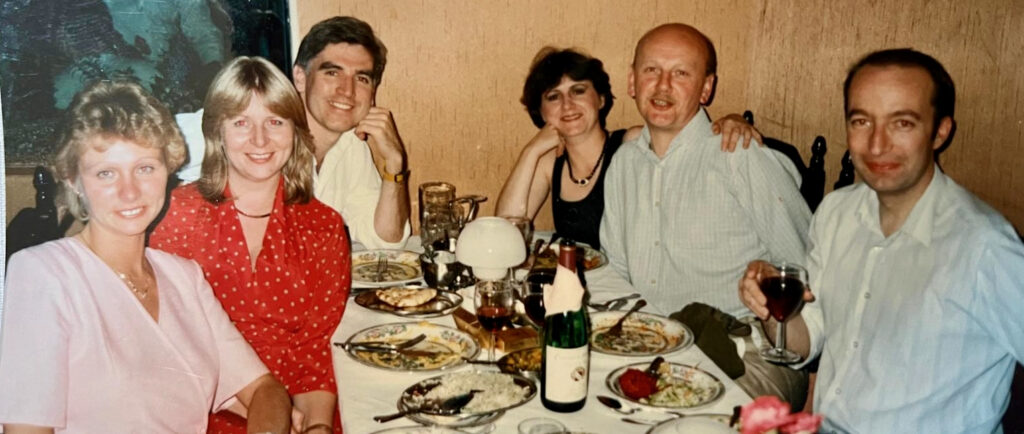
To join the staff of BHCHS in 1973 as I did was in some ways to leap back in time – some of the older staff seemed to be not just from an earlier decade but from a previous century, and some of the younger to have been acquired like furniture, ready-aged. John was a shining exception. Foot-loose and all too evidently fancy-free, he bounced balletically into the staffroom as fresh at the end of a period as when he left, full not only of energy but also flamboyance and élan; I never sat in on one of his lessons, but walking past his room was to see classes transfixed at a virtuoso performance. There could be heard laughter: in some other classrooms, learning hurt. Ex-students reading this may not have realised that the curtain did not come down at the end of their lesson but was merely the prelude to a five-act extravaganza followed by the post-production party. His Woodford pied à terre was a social hub – for the only society that mattered, of course – even if its dimensions did not permit the swinging of a cat; not that one would have attempted this with his ferocious ginger tom, Fazzoletto (named not only for girth but, as in Verdi’s Otello, an instrument of doom). To be with John socially was to be amazed and similarly inebriated by his joie de vivre – he lit up a room when he entered: like Falstaff, not only witty in himself but the cause of wit in others. Actually, the comparison with Falstaff would have been more appropriate in his earlier years – his home displayed a birthday card with the legend “Billy Bunter loves Rita Hunter” – Miss Hunter an amply constituted Wagnerian soprano. By the time I met him, he had lost a lot of weight, fitting into 28 inch waist trousers; he cut out the comb-over, grew a moustache and, thanks to a pay rise for teachers and the magic of credit cards, his wardrobe, record collection and debt grew exponentially.
There was though something obsessional, almost manic about the maintenance of this façade and it did begin to take its toll. He always suffered from insomnia and had periodic bouts of depression – there were occasions when he simply walked out of school. In my production of Twelfth Night, for example, he was a marvellous Sir Andrew Aguecheek, but until the actual performance, I was in doubt whether he would take the stage. In the event, something – call it esprit de corps, or more likely rioja – got him through it. Sadly, a mooted staff production of Rattigan’s Harlequinade with him in a rôle that suited him perfectly (pure ham, darling) never materialised. He was happier in John Rippin’s musical arrangements for the optimistically named Buckhurst Sinfonia, where a prominent part in the percussion department satisfied all his leanings towards melodrama without taxing him beyond having to count up to four – something which, as John Rippin said, was beyond the musical abilities of the side-drumming Deputy Headmaster (allegedly a maths graduate).
It would be all too easy to classify John as a typical opera queen, but his response to music went much deeper and was a major factor in his life. In fact he almost did not become a teacher – he wrote to the head of Covent Garden begging a job of any kind there; Sir David Webster, for better or worse, interviewed him and talked him out of this. I remember him explaining to me how Tosca at a vital moment believes God will forgive her jealous outburst in church (and ultimately her murder of Baron Scarpia) because passion and pain are intimately intertwined. He knew by heart the Italian text for this opera and understood from the inside its sub-text. John never stuck to the predictable – hearing one beautiful aria by Dvorak, he went out and bought as many obscurely Slavonic operas as Barclaycard would let him. Obviously, we were fascinated by one entitled “The Devil and Kate”: we both thought Miss Coulson would win that battle, though, to be fair, she was particularly kind to the two of us she called “my boys”. If you had asked me to guess which composers would never figure at his funeral, Sibelius and Handel would be high on the list, but there they were.
The aria he loved that spoke to and of him most eloquently came from Strauss’s Arabella: Aber der Richtige. Glorious music: she sings of the man who is the right one – “he will stand before me, all at once, his eyes on me, mine on him, and no more doubting will remain, no more asking, and I shall be happy and obedient as a child.” John dreamed of this happening to him. But Arabella also sings, in the prelude to this aria: “A man may quickly mean much to me, but suddenly he means no longer anything.” And this was closer to John’s actual experience, running the risk of queer-bashing, of arrest and, at the end of the 1970s, the threat of Aids. Sadly, as far as I know, he had no enduring loving partnership in his life. In fact, any friend whose emotional proximity became uncomfortable he would quite ruthlessly cut out of his life. Several at his funeral who had been his closest friends at one time, who (like me) had loved him, had stories of the hurt this rejection entailed. He had a gift for inspiring affection, but not, arguably, one for reciprocity.
I had only intermittent touch with him after he left BH: I never knew whether his subsequent placement at a North Essex unit for pupils excluded from mainstream education was his choice or a peculiarly cruel effect of the ironically named “carousel” for distribution of jobs after the school closure. At any rate, it gave him a fund of stories about the “penal colony” as he called it. And yet, in a way, being relieved of responsibility to do anything other than survive to the end of the day rather suited him. He often told me that his ideal job would be as a “trolley dolly” at Tesco; when he left Brentwood School to go to Norfolk, long before he might have been expected to retire, this was a step in the direction of such release.
I have played the organ at enough funerals to know that when all the personal qualities of the deceased have been adumbrated, the question is left, what did this life achieve, what did it amount to? I can say that the years I was close friends with John at BH were quite wonderful. Knowing him changed me as a person; I still throw in phrases that were part of his lexicon: “May these be the worst of our days” as a toast; “Shitbags” as a swearword, or “sacs de merde” when in France; “We need to sacrifice some more virgins” when the weather turns beastly. There are pieces of music I cannot listen to without thinking of him, imagining him there; arias revisited with sadness after his death. And yet, that time came to an end. I believe though that his years at BH were, like those of Miss Jean Brodie, his prime; lucky those ex-students reading this who had him as a teacher or form tutor. He was – excuse the clichéd pun – a class act.
I cannot close this without a tantalising postscript. Throughout his time at BH, John, like Kenneth Williams (whom in many other ways he resembled) kept a diary – obsessively, a page of A4 every day. He was a gifted writer (and lively correspondent) as well as raconteur; I imagine these diaries give a far better picture of his life and the life of the school at that time than any increasingly vague memories of such as myself. As in the famous cartoon of his beloved Jane Austen, perhaps they may be deemed fit for publication “when all the effing and blinding are taken out”.
Leave a Reply