
A report from the BHCHS Alumni Survey — Jon Whittle and Nick Allum · August 2026
The survey asked two simple questions: your father’s occupation when you started at BHCHS, and your own main occupation in adult life. Some 984 of you answered both — enough to trace class movement across two generations. In sociologists’ shorthand there are three broad classes: professional and managerial work (the ‘salariat’), intermediate occupations (clerical, sales and service), and manual working-class jobs.
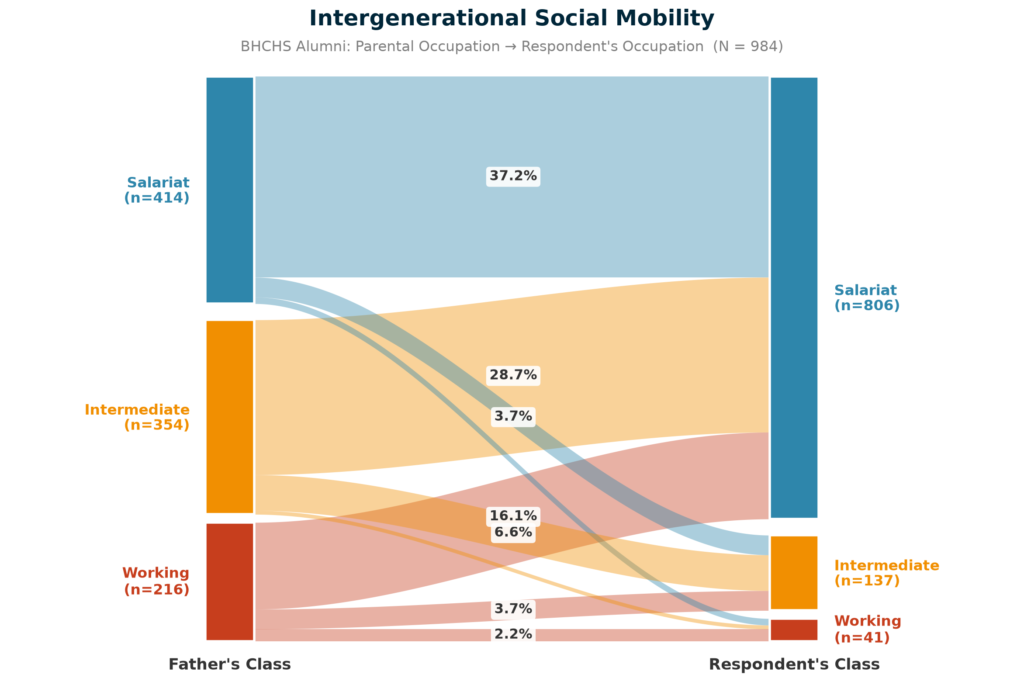
Figure 1 shows what happened as a river flowing from fathers to sons. Our fathers were a mixed lot: of the 984, 414 held professional or managerial jobs, 354 intermediate, and 216 manual. Their sons were not mixed at all: 806 — 82 per cent — ended in the salariat. Nearly half of us finished above our fathers; most of the rest stood still, usually for want of anywhere higher; about one in twenty moved down. How unusual is that? In national surveys of the same generations, roughly one in six working-class sons reached the salariat. Among the working-class sons answering our survey, seventy-three in a hundred did. ‘First of my family to reach a grammar school,’ one wrote. ‘Both parents had to leave school at 14.’
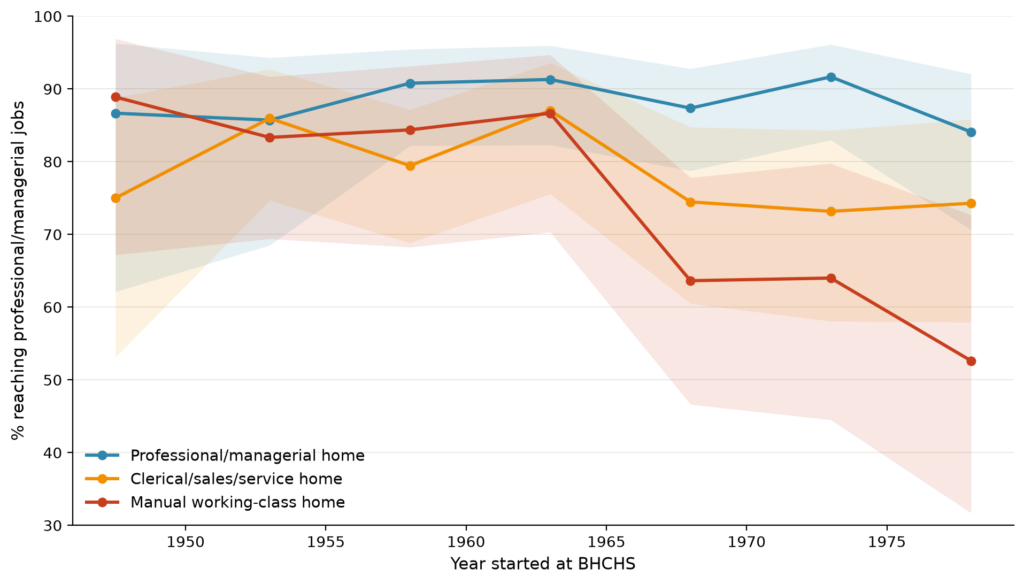
Within that story sits a stranger one. For boys who started in the fifteen earliest year cohorts in the survey, 1945–59, a father’s class made almost no difference at all: a bricklayer’s son or a banker’s son, the chance of a professional or managerial career was much the same among us: about 85 per cent — though a grouping this broad may hide finer differences. Two engines drove this. The first was the eleven-plus: by the time a boy first walked down Roding Lane, the sorting was done and home advantage largely spent at the gate. The second was the times. Half the working-class boys in our sample from that era left before the sixth form — far more than from professional homes — yet it mattered far less than it later would: three in four of those leavers reached professional careers anyway, recruited at sixteen by banks, insurance offices and the civil service. ‘Careers advice was… bank, insurance, preferably stay on for further education,’ one early leaver recalls. The earliest numbers deserve holding lightly: our oldest respondents are by definition the long-lived, and fortune in health and fortune in careers may travel together.
It did not last. Figure 2 traces each group’s chances across the school’s life, and from the late 1960s the lines pull apart. Among our respondents, boys from professional homes went on reaching the salariat — professional and managerial work — at around nine in ten right to the end of the selective era; for boys from manual working-class homes the figure slips to around 64 per cent for the 1966–75 intakes and — on small late-year numbers — 53 per cent for 1976–80. Beyond that the survey runs out of road: the 1981–89 intakes give us just 67 of you, schooling interrupted by the closure itself, so about the comprehensive years we say nothing. Two changes lie behind this widening gap. The sixteen-year-old’s route closed: the handful of working-class boys in our 1970s intakes who left early rarely reached the salariat; the qualification had become the ticket. And staying on was itself tilted by class: the post-war gap in sixth-form entry among our respondents had closed almost completely in the 1960s, then reopened in the 1970s, just when it mattered most. For those who cleared every hurdle, the reward could still be spectacular: ‘The school was for me a real social mobility enabler. I was … the first person in our family to go to university, and the brilliant history teaching enabled me to win a scholarship.’
Is this proof the school levelled the field? Honesty requires a harder answer. The eleven-plus chose boys of similar academic promise, so like was compared with like from the first morning; what became of the boys sent to the secondary modern lies outside our survey altogether; and the men who join an old boys’ association and fill in its questionnaire sixty years on are unlikely to be those the years treated worst, so our percentages are best read as generous. National research that followed everyone born in one week of 1958 — grammar and secondary-modern pupils alike — finds the selective system gave the country no overall mobility advantage. Nor was the escalator frictionless for those riding it. One respondent remembers his parents being told by the headmaster, at a parents’ evening, that he ‘could forget a career in law or medicine because we were “working class”. This was not ill-intended by him. It was the reality of that era.’ He built an export career anyway — but through a landscape where class was never invisible: merely, for a while, less decisive.
What our survey describes, then, is not a school that abolished class but a machine inside which, for a generation, a boy’s origins mattered astonishingly little. It rested on two vanished institutions: an examination at ten or eleven that did the sorting, and a labour market that took a sixteen-year-old into a career on the strength of his school’s name. Both went before the school did. Whether their passing was progress or loss will divide our respondents as it divides the country. The last word goes to a man who counted himself a working-class boy: ‘Not great being a working class boy at the school. Set me up for life though, so thank you!’
Analysis covers the 984 respondents (of 1,109 completed questionnaires) reporting both occupations, classed on the Goldthorpe scheme. All figures are from the survey except those explicitly described as national (Goldthorpe and Mills’s general-population studies; Boliver and Swift’s birth-cohort analysis). Shaded bands in Figure 2 are 95 per cent confidence intervals; the closure-interrupted 1981–89 intakes are omitted. Quotes are respondents’ own words, lightly edited for spelling and punctuation, omissions marked by ellipses.
We used Claude (Anthropic) to assist in drafting and debugging the R code for data cleaning and statistical analysis, and to copy-edit the text. All code and outputs were checked by the authors, who take full responsibility for the results and their interpretation.
Leave a Reply